
In Singapore, Band Massive Attack Is Out, But Israeli Defence Companies Are Here to Stay
Singapore, a country long known for its strict limits on freedom of expression and public protest, has decided to ban the British band Massive Attack from entering the country after two of its members held up a Palestinian flag during a concert last Wednesday (July 29) and shouted, "Free Palestine."
Just eight months earlier, in November 2025, Singapore joined a growing list of countries in imposing sanctions and entry bans on Israeli far-right activists over their "involvement in acts of violence against Palestinians in the West Bank". Singapore's Foreign Ministry explained that "these acts of violence are contrary to international law and undermine the prospects for a two-state solution", and also called on the Israeli government "to curb settler violence in the West Bank and bring the perpetrators to justice".
This conduct may appear contradictory, but it reflects the tensions that have long defined Singapore's relationship with Israel. On the one hand, the Singaporean government seeks to safeguard its international standing, particularly in Southeast Asia. On the other, it is determined to preserve its close ties with Israel while seeking to prevent public opinion in Singapore from turning against those ties, as has happened in other countries.
Despite Singapore's periodic criticism of successive Israeli governments over the Palestinian issue, the reality is that for several decades Singapore has served as a regional hub for Israeli defence companies operating across Southeast Asia. Israeli firms maintain permanent offices and staff there, benefiting from the country's high quality of life while marketing their products and services throughout the region. From Singapore, they also dispatch personnel to provide training and maintain Israeli-made equipment sold across Southeast Asia.
In 2005, details about the origins of the security relationship between the two countries were made public. Among the revelations was that in 1965, following Singapore's independence, Israel helped build the country's armed forces from the ground up. To conceal the Israelis' identity, the Singaporean government referred to them as "Mexicans". In addition to providing advice and training, Israel sold Singapore substantial quantities of military equipment.
The project was overseen by Major General Rehavam Ze'evi, who was widely known for his extreme fascist and racist views. After his death, testimonies emerged alleging that he had executed prisoners of war and sexually assaulted female soldiers under his command. Ze'evi was assassinated by the Popular Front for the Liberation of Palestine in 2001.
On April 19, 2016, Singaporean Prime Minister Lee Hsien Loong visited Israel and, during a joint news conference with Prime Minister Benjamin Netanyahu, publicly recalled the early years of the two countries' security relationship:
"Our universities and research sectors have also strong collaborations, and there are many exchanges between our institutes. But really it all started with a defense relationship. We are very grateful to Israel that when independence was thrust upon us in August 1965 and when Singapore's security and survival were in doubt, you helped us, the IDF helped us to build up the Singapore Armed Forces when other countries turned us down.
It's been a long time since I visited Israel. The last time was in 1977 as a young army officer accompanying our Chief of General Staff, who's now our ambassador here. And I'm very delighted to be here again. Yes, General Winston Chu, who has been, who has known Israel for many years. And I'm very happy to be back here again after all these many years to thank you personally and to thank Israel for your help and support over the years."
Recently, files from Israel's Foreign Ministry dating to the 1980s were partially opened at the Israel State Archives, adding another piece to the puzzle of relations between the two countries.
According to diplomatic cables, Israel Aerospace Industries had maintained an office in Singapore since at least 1982. In April 1983, Israel appointed a military attaché to the country. In June 1983, Singapore's defence minister, Goh Chok Tong – whose visit to Israel was classified as "secret" – travelled to the country. He would later succeed Lee Kuan Yew as Singapore's second prime minister in 1990.
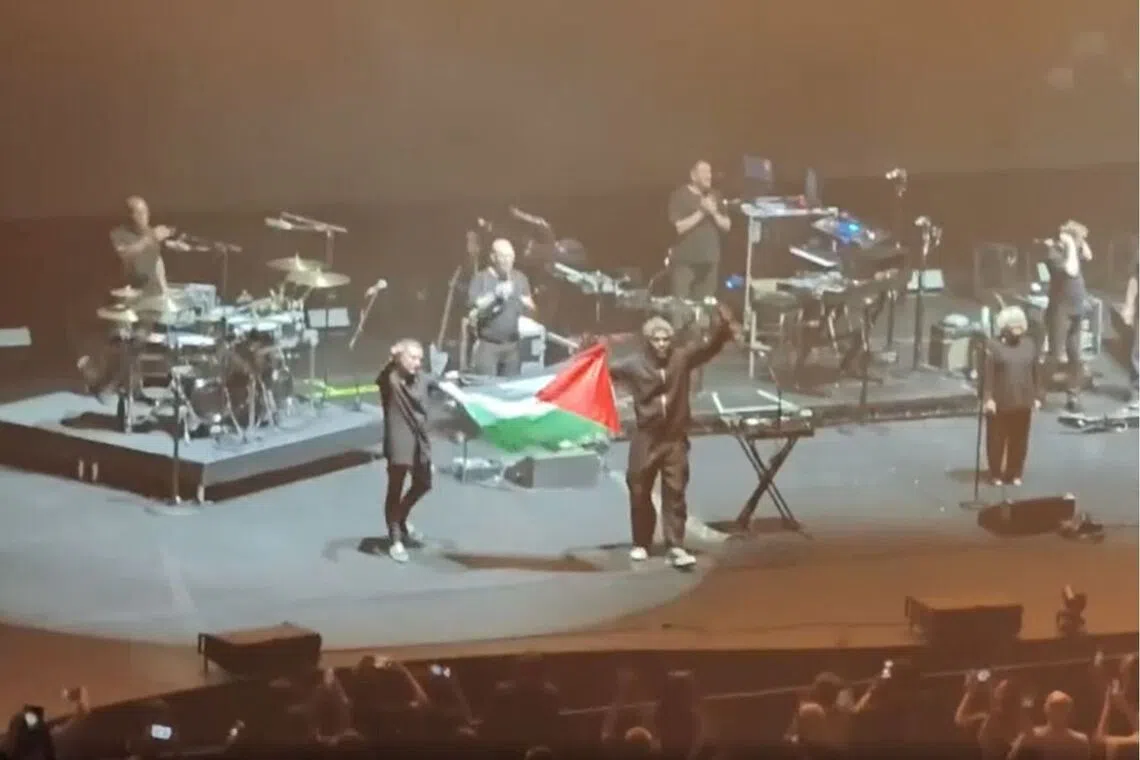
Members of the band 'Massive Attack' hold up a Palestinian flag during a concert on July 29, 2026. Photo: Screengrab from video
In a cable dated January 7, 1985, Israeli Ambassador Moshe Ben Yaacov wrote that Goh was "friendly toward Israel, and our relationship with him has grown closer during his tenure as defense minister. In June 1983 he visited Israel and met with Prime Minister Begin, Foreign Minister Shamir, and Defense Minister Arens. His visit to Israel left a deep impression on him. Over the past year in Singapore he met with Foreign Ministry Director General Kimche, Defense Ministry Director General Maron, and myself. He recognizes the benefits to Singapore of cooperation with Israel and is working to strengthen the relationship."
According to a memorandum from Foreign Ministry Director General David Kimche's visit on February 10, 1984, he met with Prime Minister Lee Kuan Yew, who told him: "Singapore owes Israel a debt of gratitude for the assistance it provided in our country's most difficult early days. Our requests to Britain, Australia, India and Egypt went unanswered. Israel offered military assistance through its ambassador in Bangkok, and then I said to the defense minister: Go ahead."
In a cable sent on September 21, 1984, Ambassador Ben Yaacov wrote that he had met with Singapore's foreign minister and discussed "increasing the number of IDF advisers in Singapore and expanding military assistance." In another cable, sent on July 1, 1985, he wrote that he had again met with the Singaporean foreign minister and discussed cooperation with the Mossad. In this context, a Foreign Ministry briefing prepared on September 24, 1985, noted that "Israel-Singapore relations are characterized by mutual trust, reflected, for example, in the sharing of sensitive information with us and consultations with us."
In a cable sent on March 20, 1986, Ambassador Ben Yaacov wrote that "in July 1985 a Singaporean delegation headed by Cheong Quee Wah, First Permanent Secretary of Ministry of Home Affairs, visited Israel to study counterterrorism. Members of the delegation were guests of the Foreign Ministry and held meetings with the prime minister's counterterrorism adviser, the police commissioner, and officials from the IDF... As a result of the visit, a direct working relationship was established with the prime minister's counterterrorism adviser."
In a briefing prepared by the Foreign Ministry in March 1987, diplomats wrote that "Singapore, hemmed in between Malaysia and Indonesia, serves as a center for Israeli activity in Southeast Asia," and noted that Israeli exports to Singapore totalled approximately $56 million in 1985. The briefing also stated that defence ministry director general David Ivry visited Singapore in May 1986 and met with defence minister Goh Chok Tong, and that Israeli Chief of Staff Moshe Levy visited the country in February 1987.
Even then, there was a clear gap between Singapore's public condemnations of Israel in international forums and the close, confidential bilateral security relationship. The briefing observed that "a problem in relations with Singapore is its voting record in international forums, where it supports most anti-Israel resolutions," while also noting that "Singapore has still not opened an embassy or economic mission in Israel, and such a development is not expected in the near future. However, in September 1985 a confidential mission of the Singaporean Ministry of Defense began operating in Israel."
Another briefing, prepared in August 1987, explained that the low profile of the security relationship stemmed primarily from opposition by neighbouring Malaysia, Singapore's desire to secure the support of Non-Aligned Movement countries in international forums on the Cambodia issue, and its economic ties with Arab states, which included importing $2.5 billion worth of oil from them and exporting $1 billion worth of goods to those countries in 1986 alone. Nevertheless, the briefing concluded that "despite these constraints, there is great appreciation for Israel, whose considerable assistance during the early years of independence remains to its credit, as does its continued readiness to cooperate with Singapore from then until today."
Most Foreign Ministry files remain classified. But the documents from the 1980s that have now been released add another piece to the puzzle – not only of Israel's relationship with Singapore, but also of how Israel's security and diplomatic ties with countries across Southeast Asia evolved into what they are today.
While Massive Attack is no longer welcome in Singapore, the country's role as a regional hub for Israeli defensc companies appears to be as secure as ever. Despite growing international scrutiny and periodic criticism of Israeli policies, there is little indication that the Singaporean government intends to loosen its longstanding security ties with Israel anytime soon.
Eitay Mack is an Israeli lawyer and human rights activist.


